Determining the Cause
Chief Complaint: Headache
a. History: Sudden Severe Headache
Differential Diagnosis
| Most common causes | Less commonly causes | Uncommonly causes |
| Subarachnoid hemorrhage | Cerebral infection (eg, meningitis, acute complicated sinusitis) | Pituitary apoplexy |
| Reversible cerebral vasoconstriction syndromes (RCVS) | Cerebral venous thrombosis | Colloid cyst of the third ventricle |
| Cervical artery dissection | Aortic arch dissection | |
| Spontaneous intracranial hypotension | Aqueductal stenosis | |
| Acute hypertensive crisis | Brain tumor | |
| Posterior reversible leukoencephalopathy syndrome (PRES) | Giant cell arteritis | |
| Intracerebral hemorrhage | Pheochromocytoma | |
| Ischemic stroke | Pneumocephalus | |
| Retroclival hematoma | ||
| Spinal epidural hematoma | ||
| Varicella zoster virus vasculopathy | ||
| Vogt-Koyanagi-Harada syndrome |
| Next Pivotal Assessment | Findings | |
|---|---|---|
CT without Contrast*
|
Subarachnoid Hemorrhage |
Intracerebral Hemorrhage |
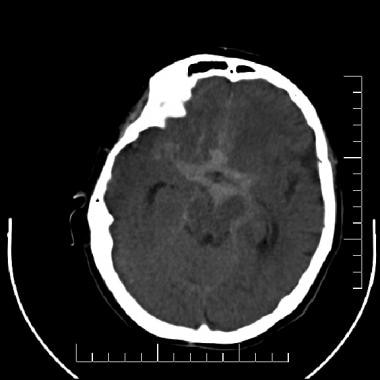

*Patients with an abnormal neurologic examination or a history of recent-onset headache should be evaluated by a computed tomography (CT) or magnetic resonance imaging (MRI) study of the brain.1 A general evaluation of acute headache might include cranial arteries by palpation; cervical spine by the effect of passive movement of the head and by imaging; the investigation of cardiovascular and renal status by blood pressure monitoring and urine examination; and eyes by funduscopy, intraocular pressure measurement, and refraction.
Reference
1. Goadsby PJ. Headache. In: Loscalzo J, Fauci A, Kasper D, Hauser S, Longo D, Jameson J. eds. Harrison's Principles of Internal Medicine, 21e. McGraw-Hill Education; 2022. Accessed October 05, 2024. https://accessmedicine.mhmedical.com/content.aspx?bookid=3095§ionid=262789353